

Contemporary women’s art is no longer content simply to answer the question, “Who are women?” as a matter of identity.
The more significant questions are shifting: How do women see the world? How do they draw upon their bodies, memories, experiences, emotions, and inner lives to establish new relationships between the self and the world?
If, over the past few decades, women’s art has often taken on the task of reflecting upon structures of gender and power, the work of a growing number of younger women artists today is moving beyond questions of identity toward a deeper construction of subjectivity. Rather than seeking to prove or define themselves, they are creating ways of seeing that are distinctly their own—new systems of perception and new spiritual spaces that depart from established narratives.
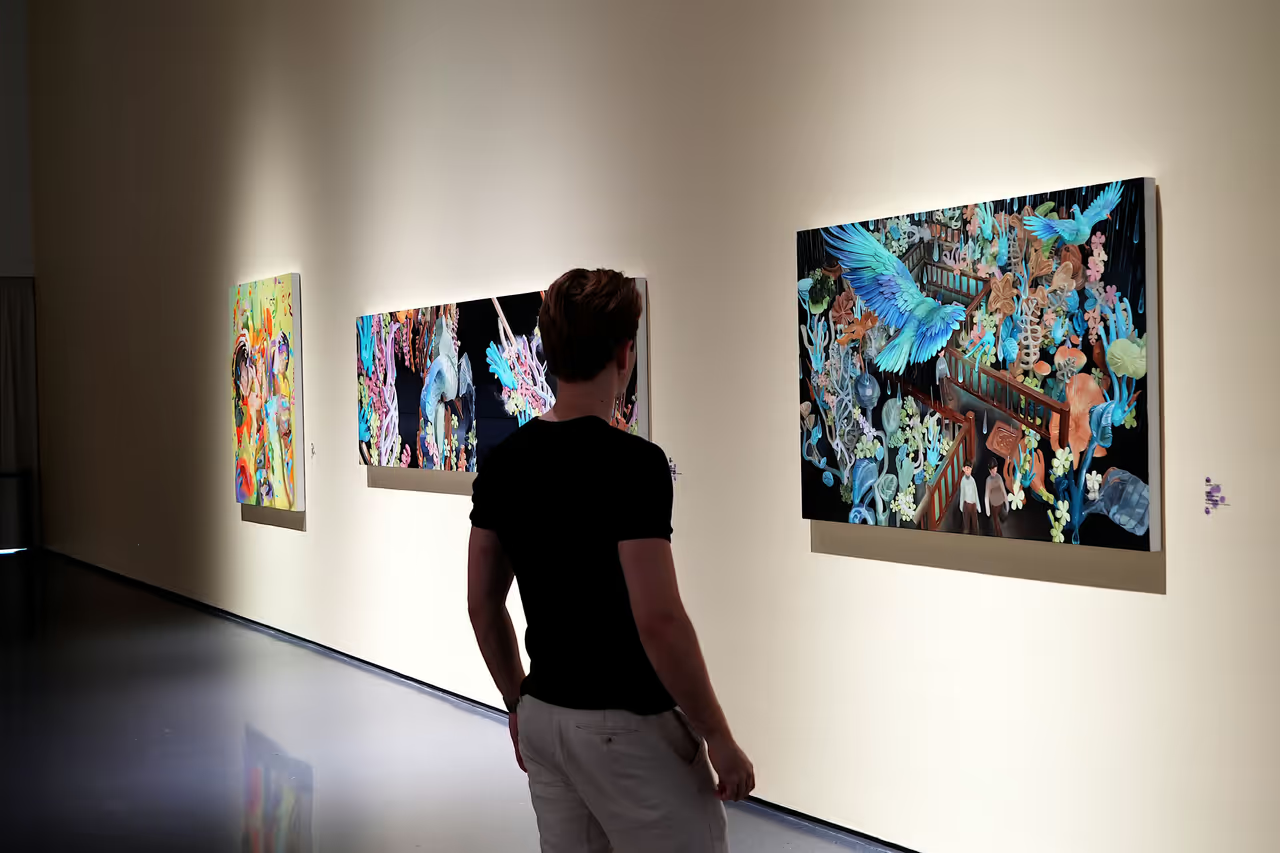
The artists in this exhibition work across different media—including oil painting, mixed media, installation, and moving image—yet their practices reveal a shared and noteworthy tendency: they continue to grow inward.
This inward movement is not a retreat from reality. Rather, it is a search for deeper spiritual structures within reality itself.
Some transform the uncertainties of a fluid age into abstract and open-ended inner landscapes. Some preserve the most delicate traces of personal memory within everyday objects. Some return to historical imagery, seeking for alternative possibilities for women’s lives through processes of deconstruction and reconstruction. Others turn to mountains and rivers, the cosmos, celestial phenomena, and the order of nature to reconsider the ancient and enduring relationship between human beings and the world around them. Still others explore the ever-shifting boundaries of consciousness and the soul through worlds in which the body, mythology, religion, and fantasy intertwine.
Their work is not concerned with defining a singular “female experience.” Instead, it continually expands the very possibilities of experience itself.
The body is therefore no longer merely the body, but a vessel through which the world is perceived. Landscape is no longer simply nature, but a site upon which the inner world is projected. History is no longer only the past, but a text that can be rewritten. Abstraction no longer refers merely to form, but becomes a language through which existence can be contemplated.
Together, these artists resist singular narratives.
They resist being defined by any fixed identity, just as they refuse to confine their practices within established discursive frameworks. They engage with reality while moving beyond it; they respond to their time while continually returning to the individual; they trust lived experience while searching for broader spiritual dimensions that extend beyond experience itself.
This exhibition, therefore, does not attempt to define “women’s art.”
In fact, there is no single, unified form of women’s art. What deserves our attention is what happens when increasing numbers of women become active subjects of artistic creation: they bring new forms of knowledge, new modes of perception, and new visions of the world into contemporary art.
Their practices are not simply additions to the traditional history of art. They are reshaping the very ways in which art apprehends the world.
From the intimacy of everyday life to the vastness of the cosmos; from personal memory to collective history; from bodily experience to the inner world, these artists continually cross boundaries that were once treated as fixed. Within their work, reality and fantasy, history and the present, nature and civilization, body and soul are no longer positioned as opposites. Instead, they reconnect through states of movement, transformation, and flux.
Perhaps this is one of the most significant meanings of women’s art today.
These artists are not creating another world. Rather, they remind us that the world has always contained far richer and more complex layers than established narratives have allowed us to see.
What is needed is another way of looking.
And these artists are becoming the creators of that way of seeing.