

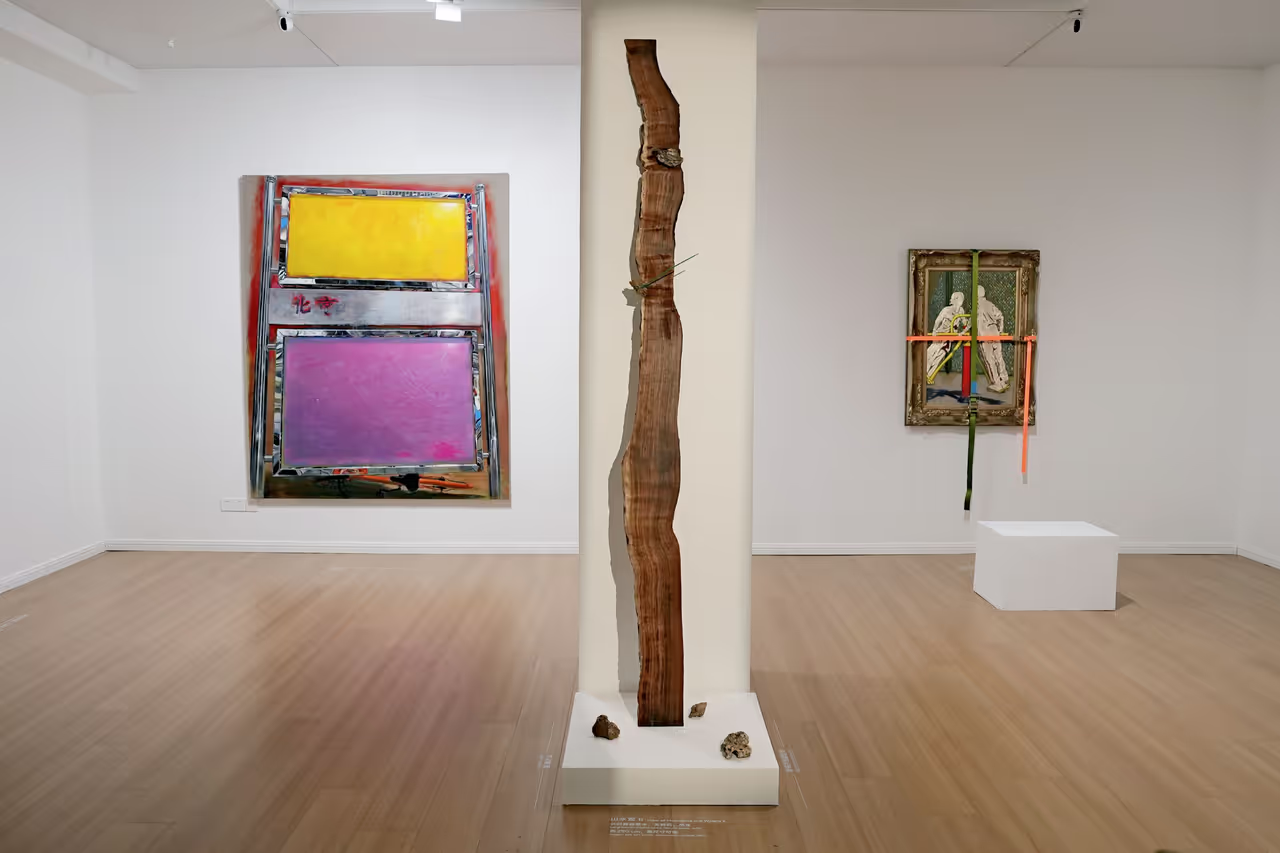
Zang Kunkun’s art does not proceed from any pre-existing or stable artistic style. Rather, through a continuous process of reflection, he has gradually developed a creative logic constituted by personal experiences of growing up, an awareness of “energy/potential,” a consciousness of the classics, formal order, observations of reality, and ongoing experimentation and trial and error. Particularly noteworthy is his reluctance to define himself through any fixed “style.” Instead, he understands artistic practice as a process of continually discovering, negating, and reorganizing himself—or, more precisely, his ideas.
From “Energy” to “Reality”
Like that of all artists, the deepest origins of Zang Kunkun’s art are closely connected to his formative experiences. His childhood was marked by a relatively unrestricted, almost “half-wild, half-free-range” existence: climbing mountains, swimming, exploring nature and abandoned industrial environments, while also spending long periods drawing alone. His parents were generally supportive of his artistic pursuits without intervening excessively. His very first drawing in primary school received his teacher’s approval, followed by setbacks during junior high school and a renewed commitment to art in senior high school. This sequence of “freedom—affirmation—setback—recovery—renewed challenge” was subsequently transformed into a central concept in his practice: energy is, in essence, potential—the capacity of an individual to continually discover, develop, and enhance their own abilities.
Thus, the pipes, steel tubes, roofing felt, electric blankets, bones, and other elements appearing in his works are not merely materials or exercises in formal experimentation. Rather, they are organized around relationships of “expenditure—protection—transmission—recovery—circulation.” Pipes suggest transmission and sublimation; roofing felt implies the protection of vital processes; and the fatigue and recovery associated with physical exercise become lived experiences of an “energy cycle”—a phenomenon that can hardly be described as either purely rational or purely instinctive.
The artistic influences on his practice are equally distinctive. On the one hand, he encountered Western artistic traditions at an early age through publications such as Drawings by Great Masters of the World, and was influenced by the pictorial traditions of Holbein, Dürer, and Velázquez. On the other hand, he has explicitly acknowledged the profound influence of Joseph Beuys and Chen Zhen. Beuys enabled him to recognize the relationship between art and the spiritual reconstruction of society, while Chen Zhen’s works concerning the body, illness, and the conditions of life reinforced his interest in the relationship between “body and energy.”
At the same time, he has maintained a particular fascination with the “classics”—even a desire to pay homage to them—because, for him, the classical represents a form of continuity capable of transcending time. This gives rise to a compelling tension within his art: while grounded in personal bodily experience, it continually extends toward art history and social reality—a kind of rational outcome emerging from instinct.
The Artist’s Logic of Thought: The Continuous Establishment of Relationships
One of the most significant characteristics evident in Zang Kunkun’s practice from an early stage is that his creative process does not simply begin with the intention to “criticize something” and then proceed to find a symbol through which to express that criticism. Instead, meaning gradually takes shape through the relationships established among different things.
He explicitly divides his artistic practice into two trajectories: “one concerns being with myself; the other concerns my relationship with the world.” The former involves exploring his own potential, while the latter gradually turns toward observations of social reality. The interplay between body and consciousness causes his artistic practice to move continually among different possibilities, including discoveries arising from chance.
Fitness equipment offers a representative example of this transition. Beginning with the linear and geometric forms of bones, he came to associate them with exercise machines, and subsequently moved from the relationship between the body and fitness equipment toward broader relationships between individuals, the city, and society.
His mode of thinking may therefore be summarized as follows:
Material/Form → Association → Transformation → Metaphor → Social Meaning.
This process is not linear but continually recursive. As he describes it, his practice consists of “small series nested within other small series to form a larger series,” through which he repeatedly supplements, overturns, and refines his ideas. Formal elements must maintain close relationships with one another; they cannot depart from the existing system merely for the sake of novelty.
This also explains his particular emphasis on “order” and “logic.” He has even characterized his artistic practice as “using reason to substantiate sensibility.” Rather than employing reason to suppress sensibility, he uses rigorous composition, perspective, materials, and formal organization to give lasting form to sensations that are initially intensely personal and contingent. At times, however, social consciousness and the judgments it entails also intrude abruptly into the work at hand.
Ambiguity, Illusion, and Reality Within Order
The most striking visual characteristic of Zang Kunkun’s work is therefore the simultaneous presence of highly ordered pictorial structures and content that is uncertain, fantastical, seemingly unrelated, or even absurd.
The forms in his works frequently derive from the most ordinary objects of everyday life—exercise machines, pipes, measuring tapes, fur, metal, and roads. Yet through processes of dismantling, transformation, and recombination, these objects lose their original functions and become visual entities situated between painting, sculpture, and installation, often evading habitual modes of perception and understanding, whether visual or physical.
In Gilding, for example, fitness equipment is arranged into a mechanical structure resembling a production line. The gold color suggests both precious material and something unmistakably counterfeit—a symbolic metaphor that may also carry allusions to medieval religious painting. The artist himself explains that “gilding” constitutes a form of visual deception: an appearance of prosperity that does not correspond to its underlying reality.
His approach to simplification is likewise not a form of minimalism in the formalist sense. Although his early practice did undergo a transition from “addition” to “subtraction,” he subsequently began to question the treatment of “minimalism” itself as an artistic value. What truly matters to him is not the method or its external appearance, but what lies behind the form, including unexpected combinations of physical objects.
His work therefore occupies a series of thresholds: between figuration and abstraction, painting and installation, rationality and irrationality, personal experience and social reality, form and content, reality and illusion. It is precisely this condition of existing at the boundaries that constitutes his distinctive artistic language.
What, Ultimately, Does He Seek to Express?
In light of the artist’s personal experiences and intellectual logic, Zang Kunkun’s enduring concern is neither a particular political event nor a specific social phenomenon. Rather, it is a more concrete question concerning human existence: how can individuals recognize themselves, sustain their energy, and understand their relationship with the world amid continual processes of depletion, discipline, and change?
His early work centered on “my own potential”: whether he could continually explore, restore, and transcend himself. His later practice gradually shifted toward “my relationship with the world.”
Fitness equipment again provides a revealing example. On the surface, it represents modern urban life and physical health. Yet it also suggests that contemporary individuals must rely on artificial apparatuses to recover bodily capacities that should, in principle, exist naturally. Consequently, “health” itself becomes a new form of restriction, a new potential mechanism of discipline.
In this way, he transforms the most familiar everyday objects into reflections on urbanization, social order, and ways of living.
Indeed, as early as his Brown series, Zang Kunkun had already explicitly connected the “circulation of energy” with social discipline. The body is continually depleted and continually restored; the aestheticized “instruments of torture” possess formal beauty while simultaneously implying a critical reflection on power, discipline, and patterns of everyday life.
The role of color is invariably informed by shared experience, yet the functions and meanings assigned to color are determined by the artist’s own particular experiences. This is precisely why Zang Kunkun seeks out objects that, in his view, carry specific referential meanings, even though others may be unaware of their significance or origins.
Zang Kunkun’s work may therefore be understood as an artistic practice that begins with individual potential, takes the body and energy as its mediating concepts, employs formal order as its method, and ultimately addresses the relationship between human beings and reality.
What he truly seeks to preserve may not be any particular image, but rather an unstable condition of perpetual movement: continually discovering his own limitations, negating what he has already mastered, and seeking new possibilities within the unknown.
This also explains why he emphasizes his inability to be satisfied with himself and maintains that an artist cannot remain confined within an established style or structure. The classics are important precisely because they possess the capacity to resist the ephemeral, the mediocre, and the passage of time.
From this perspective, although Zang Kunkun’s works appear to concern machines, bodies, materials, gold, pipes, and fitness equipment, at a deeper level they address three interconnected questions: “Who am I?” “Who might I yet become?” and “How, ultimately, do human beings exist in this world of reality?”
The artistic significance of his work lies in its ability to condense these abstract questions into forms that are highly restrained and precise, yet charged with visual illusion. At times, even the act of questioning itself is abruptly interrupted or unexpectedly redirected.
On the basis of the contradictions between the rigorous, precise, and rational formal structures of Zang Kunkun’s artistic practice, on the one hand, and visual illusion, the estrangement of objects, and the indeterminacy of reality, on the other, I have chosen “Illusions Within Order” to characterize the results of the artist’s practice presented in this exhibition.
But what, in fact, is “order”?
Zang Kunkun’s works are precise yet ambiguous, rational yet absurd. They appear to represent reality, yet simultaneously constitute a kind of illusion. They seem to suggest bodily contact and energy, yet remain austere and materially concrete. Although the images in his paintings retain a fundamental integrity, they also acquire an installation-like quality, producing an illusion that extends beyond the pictorial plane. His works seem to contain references to the classics, yet they are also implicated in the confusion and disorder of contemporary life. Their physical dimensions are relatively modest, yet they evoke a sense of potential and an extension into the unknowable.
These characteristics and phenomena destabilize our capacity for judgment.
In this exhibition, Zang Kunkun’s works from different periods, particularly his most recent creations, raise the following questions:
1. Why do certain visual motifs—shapes, structures, objects, spaces, colors, materials, and so forth—recur throughout his work?
2. Why do the formal characteristics of his works continually move and shift among order, repetition, cutting, concealment, displacement, emptiness, assemblage, and the boundaries between painting and objecthood?
3. Why do certain materials—aluminum, wood, mesh, leather, concrete, found objects, and others—go beyond their functional roles in relation to the image and become, often in strikingly unexpected ways, integral components of the artwork itself?
4. Does the relationship between painting and other materials or objects constitute an “expansion of painting,” or has painting already been transformed into a new kind of material structure?
5. How are everyday objects detached from their original functions and transformed into unfamiliar visual signs? Such transformations seem already to exceed the conceptual boundaries of realism and abstraction. How, then, should we define the category of artistic language to which they belong?
6. How does Zang Kunkun move from “seeing an object” to “altering its structure” and subsequently to assigning it new meaning? How does this process unfold, and how should we understand the logic of thought underlying his work?
7. Indeed, despite the seemingly substantial changes in materials and scale across different series, their continuity is sustained by a shared set of visual and conceptual mechanisms. What, ultimately, is the significance of this continuity?
The result is that existence itself—regardless of whether it can actually be touched—comes to seem closer to an illusion, while so-called “order” (and even so-called “rationality”) proves to be no more than a hypothetical proposition we posited at the outset.
On the basis of the works currently known to us, I am particularly concerned with one issue: Zang Kunkun cannot simply be classified under any single category, whether “social critique,” “installation painting,” “abstract art,” or “the found object.”
The key to his practice may lie precisely in his reorganization of everyday reality, industrial materials, pictorial structures, and conceptual relationships, whereby things that originally possess clearly defined functions and meanings enter a condition that is at once rational and unfamiliar.
Existing documentation also indicates that he has long engaged in the reconfiguration of elements drawn from reality, including billboards, fitness equipment, trash bins, and industrial materials. Through this process, he has gradually placed “objects within painting” and “painting as object” on an equal footing. In his most recent works, physical objects themselves constitute new and unfamiliar entities.
Terms such as “painting,” “sculpture,” “installation,” and “mixed media” are no longer sufficient to encompass such work. Confronted with these objectively existing entities, how are we to understand “art”?
It is precisely by disrupting established aesthetic conventions and habitual modes of thought that Zang Kunkun’s work once again raises the age-old question, “What is art?”
Herein lies the greatest significance of his artistic practice.