

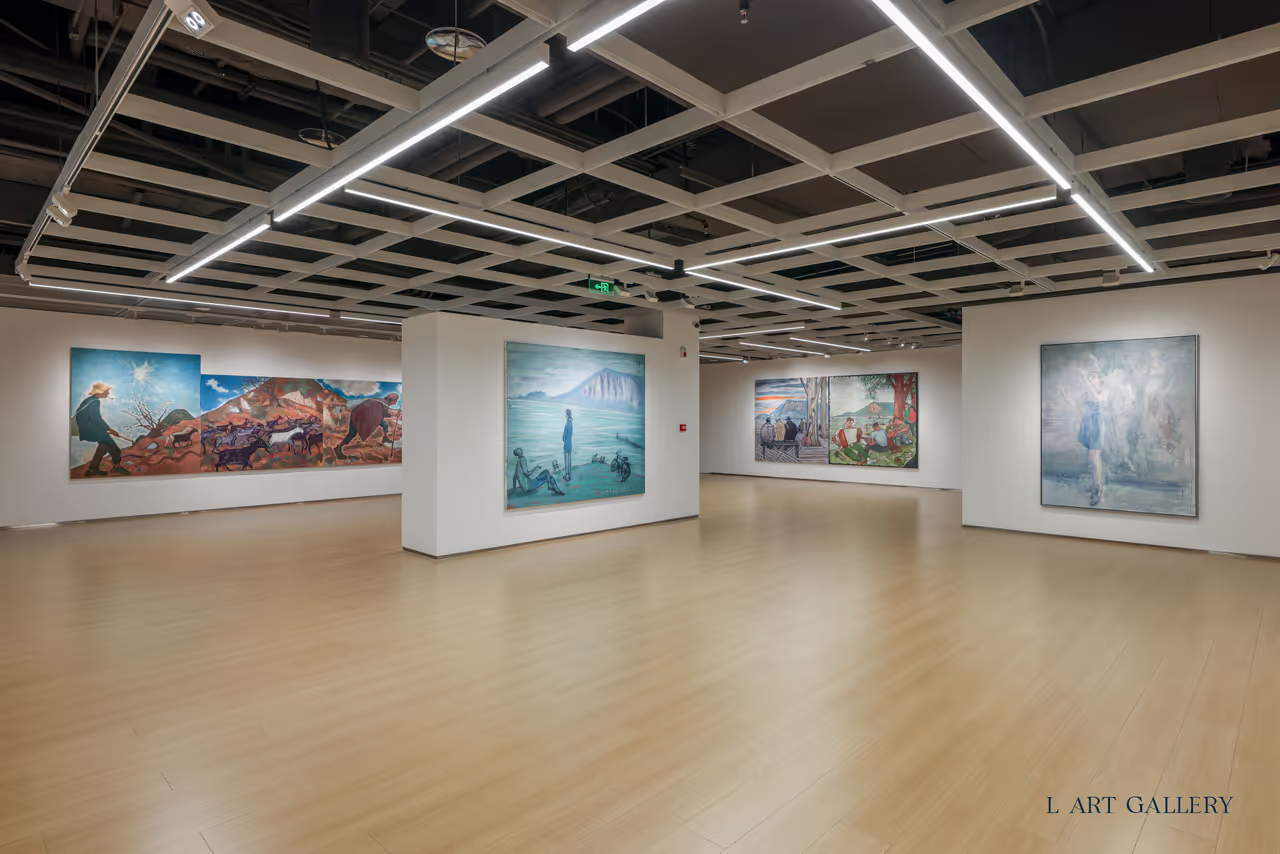
The human figure is art's oldest subject, and one that modern art has continually rediscovered. Looking back at Chinese art since the 1980s, one significant shift stands out: the person returned to the center of artistic experience. Art no longer served only to stage some grand historical, social, or collective narrative—in which the human figure functioned merely as sign or prop—but began instead to enter individual lived experience: the body, emotion, memory, desire, solitude, and a person's situation within family, society, and history. Painting thus became once again a way of confronting the person.
He Duoling and Mao Xuhui are two artists who developed their distinct artistic languages within this historical process. Both began from personal experience, both have kept the person at the core of their painting, and both have passed through decades of practice and self-revision. Yet their understanding of the person diverges along two paths: He Duoling addresses "the spiritual man"; Mao Xuhui addresses "the situated man." One uses realist imagery to enter the abstract interior of the person; the other uses an expressionist idiom to press the concrete relation between the person and the world. This divergence forms the point of departure for People in Time.
The Spiritual Man
In He Duoling's painting, the person is never a portrait subject in the simple sense. From Youth to the Russian Forest paintings, and more recently the Double Screen series, the figure remains the constant thread running through his art. But likeness has clearly never been the end in view. What He Duoling actually pursues is the emotion, memory, and spiritual bearing a figure carries—how a particular person transcends himself or herself to become a symbol of an era's experience. He has spoken of wanting his painting to "strip away the surface," so that something deeper lies hidden beneath the picture, generated through brushwork, color, and the modeling of form into a new qi, or presence. In this sense, the figure in his work is always moving from likeness toward spirit. His people are therefore at once specific and indistinct: they have bodies and faces, yet do not belong entirely to any one person in reality, even when the sitter is a friend; they arise from life but pass into memory, culture, and art history—a highly individual sensibility. What He Duoling calls the "spiritual portrait" is the fullest expression of this conception: the figure is not a record of one person's identity but may stand as a symbol of an era, a cultural experience, even a state of mind. The recent Double Screen series gives this understanding of the person a new form. A woman drawn from life and a canonical image from art history occupy the same picture: a person of today walks, looks, and photographs herself before a museum, a building, or a classic work, while the stilled history of art becomes a second space behind her, so that the instant of the present overlaps with the eternity of art history.
Here the person exists not only in her own time but in cultural time as well. A person of today standing before the art of the past both looks at history and is looked at by it. He Duoling's figures thus become, gradually, people in time: they carry the instant of present life and, with it, a cultural memory they cannot shed. This is a painting that appears altogether concrete but is, in fact, about the spiritual man.
The Situated Man
If He Duoling continually moves inward toward the person's interior, Mao Xuhui continually returns the person to reality. His art likewise begins in personal experience, but that experience has never been a sealed private world. Family, the father, power, social relations, the body, and desire have been the recurring concerns of his long painting practice. A particular person, in his work, is always caught within a relation—to family, to others, to society, to power. The Patriarch series marks the decisive turn in this line of thinking. The patriarch began as a specific figure drawn from lived experience, but through the sustained work of painting it gradually detached from any particular person to become a structural image. Once the face disappeared, power, domestic order, and the relations between people came forward all the more sharply. The figure later gave way to visual signs—a chair, a pair of scissors—so that even as the concrete person receded from the picture, the question of the person emerged more directly still. What Mao Xuhui confronts, then, is not an abstract person but a person situated within relation. Where does desire come from? Where does solitude originate? Why does the family become the site of such intricate relations between people? How does the individual meet the forces that society and history bring to bear? These questions give Mao Xuhui's painting a pronounced sense of reality—though this is not the reality of simple representation but of personal experience recast, through recurring images, spaces, and signs, into a visual structure of general significance. If He Duoling searches for the spiritual depth of the person, Mao Xuhui interrogates the conditions of the person's existence: this is the situated man.
Two Kinds of "Man," One Time
The difference between the two artists becomes clear on this basis. He Duoling attends chiefly to how the person exists within his/her own spiritual world; Mao Xuhui, to how the person exists within relations of reality. Through character, memory, culture, and art history, He Duoling elevates real-world figures into spiritual portraits; Mao Xuhui, through family, power, desire, and social relations, thrusts concrete individuals into a questioning of their existential plight. One turns inward, the other outward; one emphasizes spiritual bearing, the other worldly relation; one sets the person before memory, the other before reality. Yet the two ultimately meet on common ground: both refuse to understand the person as a simple image. Both begin from the specific person only to continually exceed him/her; both begin in personal experience only to arrive, finally, at the shared spiritual experience of an era. Neither artist's painting is a simple repetition of the past—each returns to it again and again in order to understand it anew. This is the meaning of "time" here. Time is not a backdrop external to the exhibition but the very condition on which these two kinds of person depend. He Duoling brings the person of today into encounter with art history, so that images from different civilizations and eras overlap within a single picture; Mao Xuhui allows early life experience to return, again and again, into the present, so that images once belonging to a private life take on new social and spiritual meaning. The past has never truly passed; it persists into the present as memory, image, and experience.
Neither artist has stopped exploring the medium of painting itself. He Duoling's work moves continually among Chinese traditional painting, Western art history, figures drawn from life, and personal memory. His understanding of tradition has likewise shifted from image to spirit: what is truly worth learning, he holds, is not the simple transplanting of traditional forms into oil painting but an understanding of how form and spirit unite within traditional art. Mao Xuhui, for his part, has sustained a long expressionist experiment around such motifs as the figure, space, the patriarch, the chair, and the scissors, continually endowing a visual image with new spiritual meaning. He has not abandoned painting as such for the sake of social experience; rather, he has sought, through image, color, structure, and pictorial language, to convert personal experience into a visual form of general significance. This gives their work a shared temporality. Neither is an artist who chases the surface changes of the age. Both, instead, return repeatedly to their own past: to youth, to family, to memory, to figures and images already painted, and to questions that have long troubled them. But this return is never simple repetition. The past reappears within a new time, and personal experience thereby continues to acquire new meaning.
People in Time is therefore not simply an exhibition juxtaposing two artists. We have sought instead to establish a way of seeing between two distinct artistic paths: moving from the spiritual man into the situated man, and back again from the situated man to the spiritual man. For the spirit of a person never exists apart from reality, nor is a person's situation ever only a matter of external social relation. We live within the world, and equally within our own memory, feeling, and spirit; we are shaped by our era, even as we come to understand that era through our own lived experience. He Duoling's and Mao Xuhui's painting approaches the person continually from these two directions. What they leave us is not merely the style of an era, nor simply a visual record of a life, but two distinct questions: how does a person become himself/herself, and how does a person confront the world he/she inhabits?
To look again today at He Duoling and Mao Xuhui is not to fix them within some art-historical period, but to understand, through their differing conceptions of the person, the time we ourselves now inhabit. What we truly face is no longer only the figures painted by these artists but time itself—how time changes a person, and how it changes the way we look at one. The person in time is at once a person carried off by time and a person preserved by art. Time continues to pass, and yet the spirit, memory, and situation of the person remain within the picture. This may be precisely what painting offers in facing the person: that once an era has passed, we can still see how people lived within it, how they felt, how they endured, and how they remained, still, a person.
Time passes; the person remains in the painting.